 MAKER GULLY

The first time Feeder Rater returned a score, I almost closed the laptop and called it done.
Photo in. Numbers out. Ten factors. A little paragraph of advice. I had a key, a prompt, and a loop that worked. For maybe twenty minutes I thought the hard part was over.
Then I read the advice like someone who'd never met me. Vague in places. Weirdly sure of itself. Once it was wrong in a way that still sounded helpful. I sat there staring at a screen that had "succeeded" and realizing the model had answered, but I hadn't actually shipped anything useful yet.
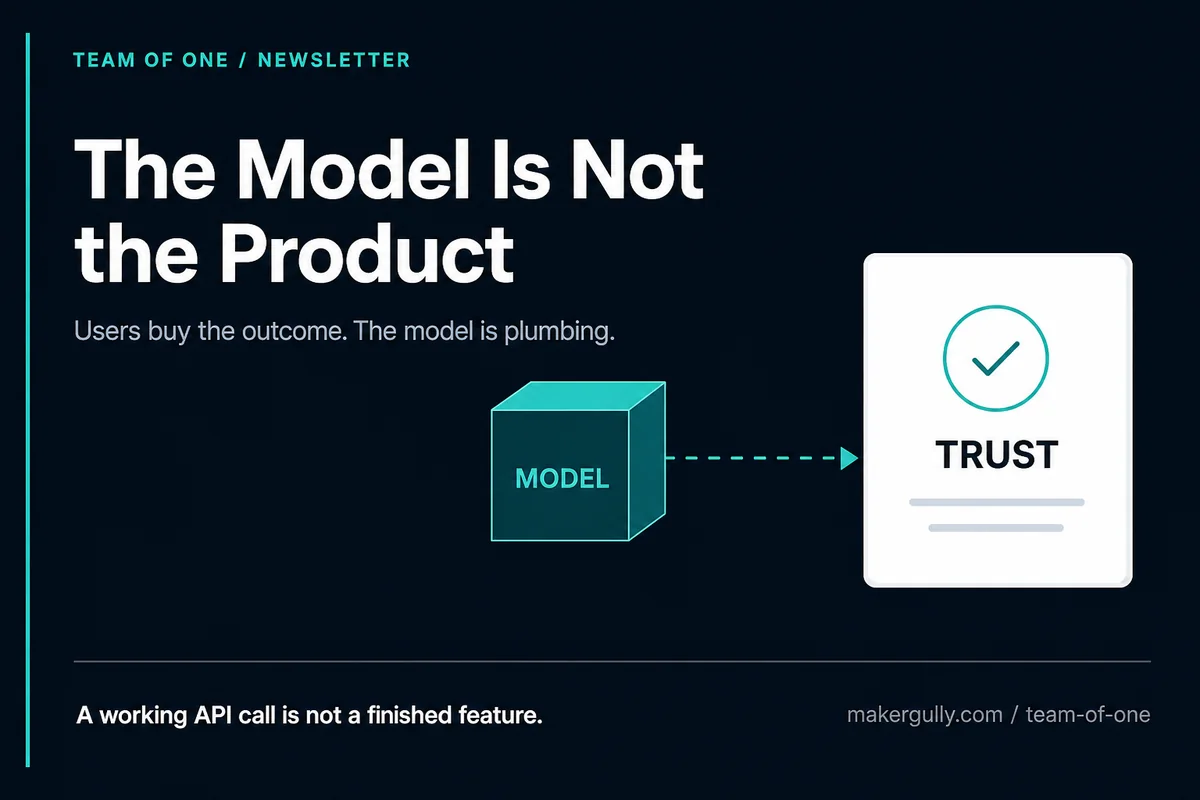
That is the quiet trap when you put AI in front of people. The demo feels like a finish line. Trust is the part that takes longer.
What someone is actually trying to do
Nobody opens Feeder Rater because they want to chat with a language model. They open it because they want to know if their setup is any good, and what to change this weekend.
Same idea on the other AI-shaped products. Identity Swap only works if the crisis feels real enough that picking a leader isn't a coin flip. America 250 only works if the image looks like a moment you might actually name. Nobody is paying (with money or attention) for "we used a model." They're paying for the answer, the argument, the second look.
I already wrote once about AI as a compiler when I'm writing code. This is different. When AI sits in front of a customer, I'm not speeding up my own night. I'm making a promise about theirs.
The boring middle that took the time
"Turn a photo into a score" sounds like one sentence. Most of the work lived in the questions around it.
What does a 7 mean when the photo is blurry? What do I show if the call times out? How specific does the advice need to be before someone trusts it enough to move a feeder three feet? If the output is wrong, does the UI admit that, or does it dress a guess up like a verdict?
On Feeder Rater, the stuff that mattered wasn't "hit the API." It was turning the response into factors someone can argue with, wording that doesn't overclaim, and a flow that still makes sense when things are slow or fail. On the history products it's the same muscle in a different costume: the model can invent. I have to keep that invention from becoming the whole brand.
You don't notice that shaping when it works. You notice it immediately when it doesn't.
Models change out from under you
A version bumps. Pricing moves. Latency gets weird on a Tuesday. A prompt that felt solid last month starts drifting. None of that shows up in the launch post.
Once AI is on the critical path, you haven't just shipped a feature. You've signed up for a dependency that can revise itself without asking. For me that shows up as watching the meter, writing retry logic, keeping fallback copy ready, and the occasional evening wondering why scores suddenly feel off.
I don't put a model in every Maker Gully product on purpose. Tap and Call doesn't need one to route a tap. FlashDrop doesn't need one to hand a file across a room. If a plain feature can do the job, I leave the tokens alone.
When a model does belong, I try to treat it like anything else I'll have to fix at 2am: keep the surface small, plan for failure, stay honest in the UI, and know what it costs me.
What I check before I ship an AI bit
Less manifesto, more notes to myself.
- Can I describe the job in one sentence without saying "AI"? If not, I'm probably shipping a demo.
- What happens when the answer is wrong? Confidence with no recovery is how trust dies.
- Structure beats vibes. Factors, labels, and a concrete next step beat a fluent paragraph of mush.
- Watch the meter. Any open door that hits a paid model is a door bots will lean on.
- Keep a path that works when the model doesn't. Empty states and plain language beat a spinner that never ends.
- Skip AI when a reliable switch is enough. Not every product needs a brain.
None of this needs a research lab. It just means not confusing "the API returned JSON" with "someone got help."
The part that keeps me honest
Models will keep getting better. That doesn't automatically mean my product gets better.
Feeder Rater is useful when someone walks away knowing what to try next. Identity Swap works when the crisis is worth arguing about. America 250 works when the image earns a second look. The model can help with all of that. It can't be all of that.
If you're staring at a working AI loop and it still doesn't feel finished, you're probably looking at the right problem. The call was never the product. Making the call worth trusting is.
That's the reality of being a team of one.
#TeamOfOne #BuildInPublic #AI #IndieHackers #SoloFounder